
No Heartbeat
Women’s grief and rage: miscarriage, oppression, and the stories we’re told to hide...

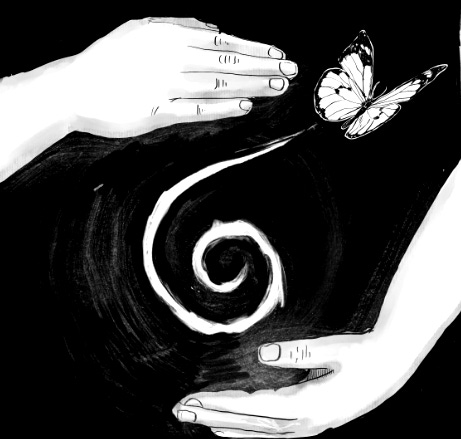
I had a miscarriage in 2019.
While I was still inside that experience, as a way to help process it, not after it had resolved, not once it had become narratively tidy, I made a graphic novel.
No Heartbeat is not a story about healing.
It is a story about rupture, rage, silence, and grief and the subsequent obliteration of self. It is about a dark tunnel of the initiation of grief and what it is like to be right inside it.
Recently, I submitted the first 20 pages of No Heartbeat to a comic award. It wasn’t selected. Rejection itself is not the point, that’s an occupational hazard of making work at all. What stayed with me was the feedback, because it echoed the very forces the work is resisting.
Too much.
Too heavy.
Too emotional.
Too dark.
Too angry.
Too political.
The art was doing too much “heavy lifting”.
Not enough.
Not enough levity.
Not enough relief.
Not enough “character”.
They were also polite, professional and complementary and encouraged me to “keep developing it”. But this did not land as constructive, helpful criticism. It landed as a polished demand to make my work consumable, palatable, light.
The worst thing about it was, it is not criticism being given to me now, five years later, as someone who has had time and distance. It is being given to me then, to the version of me who was drawing this from inside that tunnel, who had no light to offer, no humour to provide, no resolution to hand over. The person who was raw, angry and grieving and felt alone in it. I drew from my lived experience, when my grief was not instructive or symbolic but total and suffocating. This feedback was just proof to me that she was entirely alone. That when women imagine we are not understood or heard, it is real and true. We aren’t.
Their feedback was essentially “you should have made your suffering easier to consume”. That is not critique. It reaches back through time into the hell I was surviving and says:
”Tone it down, your grief must be palatable.
Your rage must be moderated.
Your suffering must offer reassurance to the reader. Get over it so they can read the happy bit quicker.”
I drew in the comic about how often I came cross this at the time. In one panel I show the time I went into a doctor’s to ask if I could have tests to find out why it had happened. He said “if it makes you feel any better, it was just a few cells”, translation; “I don’t have time for your grief, it’s invalid to me and it should be to you too”.
This was an award that claims to elevate diverse voices, and yet what they obviously didn’t realise when they gave me that feedback is that they were gatekeeping. They were uncomfortable with my work and instead of leaning into that discomfort and understanding that was the point, they ended up parroting the conditioning. The scripts that keep women constrained. The scripts that keep women oppressed. Every single day.
Why shouldn’t readers experience discomfort?
Why shouldn’t they feel lost, unsettled, disoriented?
Why is our grief and rage required to explain itself?
The disjointedness is the story.
The darkness and the rage and the grief is the truth.
Any content about women’s bodies and reproduction is political.
I imagine they thought my response would be “thank you for the feedback, I’ll take it on board”… It wasn’t. I am not going to tone this down for you either. I have spent years being asked to tame my rage to appear “professional”, while the men around me were never asked to do the same. My response as I read the way their words reflected the system was “Fuck you and your carefully worded discomfort. Fuck the polite language that disguises your fear of women’s rage. Fuck the demand that I make my pain smaller so you don’t have to face it. No one gets to judge the shape of my grief from the outside and call it critique.” To be clear, I am not angry at the people. They are people doing their best in a system that cannot metabolise women’s messy and inconvenient truth.
Let’s be honest, the message is clear;
Women’s grief is permitted only if it performs submission and recovery.
Women’s anger is permitted only if it resolves into something trivial and easy to dismiss.
Women’s bodies are permitted only when they behave as expected and in service to the system.
Women’s rage is permitted only if it does not enact change.
Women’s stories are only acceptable if they are sanitised, light entertainment or written by men.
Of course, I knew when I submitted it that it was radical. Yet a part of me hoped that someone might see how necessary this is right now. Even just within the first 20 pages there’s a woman naked roaring while giving birth, a leaking breast and a bloody tampon. It is not relenting or submissive and that’s the point.
So with that context, you can see, that the feedback was the institutional enforcement of a patriarchal aesthetic that prioritises comfort and dissociation over truth, integrity, and lived reality. It upholds the demand that women metabolise our pain in private before it is allowed into public space. Stay invisible. Stay small. Stay pleasant. Stay polite. Stay apolitical. Stay numb. If you are angry, it must be a pathology or “hormones”. Of course women don’t have a million reasons to burn this all down.
Women everyday, everywhere have miscarriages and abortions and undergo all the complexities involved in that. They do it all behind closed doors, rushing through their grief/processing so they can get back to work, making sure they don’t make others uncomfortable. Get back to the production line and don’t dare distract anyone else from their production line. Don’t forget our bodies are just machines owned by the overlords.
I was telling my human story, unsoftened, because that is what I needed when I was there. I needed someone to get into the darkness with me. I needed someone to be right there next to me saying, hey you aren’t alone in here. I see you in the dark. I see you. You aren’t wrong. This isn’t how it should be. You are feeling this within a wider context of systems and social contracts that shouldn’t exist. I didn’t need the same old “sad but hopeful” miscarriage stories. I needed the raw uncompromising power of radical honesty.
This resistance to women’s unmediated experience is not isolated. I encounter it everywhere: in publishing, art, parenting, medicine, spirituality. Women’s grief is continually reshaped to be less threatening. Women’s anger is reframed as a personal failing rather than a rational response to systemic harm. Our bodies and fertility are everyone’s property until we reveal the blood, grief and mess of it. We are not allowed to express our rage fully. We are not allowed to speak about grief, especially not the raw pain of a fertility journey that isn’t the one that capitalism conditions us for and demands. We are numbed, silenced and dissociated from our bodies every single day.
The truth is Women’s rage and anger are sacred and important, this isn’t anger that breeds control. This is fire embodied. It is the kind of rage that burns things down that should have burned down long ago. Work that expresses this kind of rage and grief is dangerous, but not to people, to the systems we uphold. Women’s nervous systems are what everyone relies on for regulation. When women are forced to stay small, polite, compliant, our communities, our workplaces, our families are stabilised. When women get angry, the equilibrium shifts. Things get wild. Systems are shaken. People notice. And that is precisely why our grief and rage are policed, they threaten the comfortable social order.
So I refuse to dilute the truth of what I made back then so that others can pass through unchallenged. Feedback that prioritises institutional comfort over lived truth is not neutral, and I will not internalise it. My work does not require permission from systems built to numb women’s rage. I am done negotiating my pain and truth into acceptability.
I am not arguing for the right to tell this story. I don’t need it to be marketable or consumable or viral, I just want it to be there for the people who need it. So I am going to find a way to publish this comic as it is. With no apologies. I don’t yet know how No Heartbeat will find its way into the world. But I know this: it was never meant to belong to institutions that cannot sit with women’s pain unless it reassures. This work is not for the system. It is for anyone who has been told their grief must be neat, digestible, or sanitised.
Maybe this is why my Substack will never be large. I don’t trade in levity. I don’t package grief as content. I don’t sand down the edges of anger to make it marketable. I don’t meme my thoughts. I don’t hide from the messy work of prising the fingers off the toxic conditioning we seem to hold onto so tightly before I throw it into the fire. I write about death, collapse, love, fear, souls, land, bodies, consciousness, myth and systems of oppression because those are the waters I am swimming in.
If that makes my work too long, too dark, too intense, too political, too angry so be it.
I am not here to be digestible.
I am not here for comfort.
I am not here to cleanse and bypass.
I am here to be truthful. I am here for those who want to engage deeply with these conversations and unpacking the depth of what it means to be alive right now.
And I am here, still learning how to be seen without disappearing, shrinking and playing along as I have been thoroughly conditioned to do my entire life.
Stand strong in your power and rage Sarah, the world needs this truth. 💥
Commercial publishers are extremely conservative, they never take ‘risks’ ever, it’s very sad and very restrictive for artists.